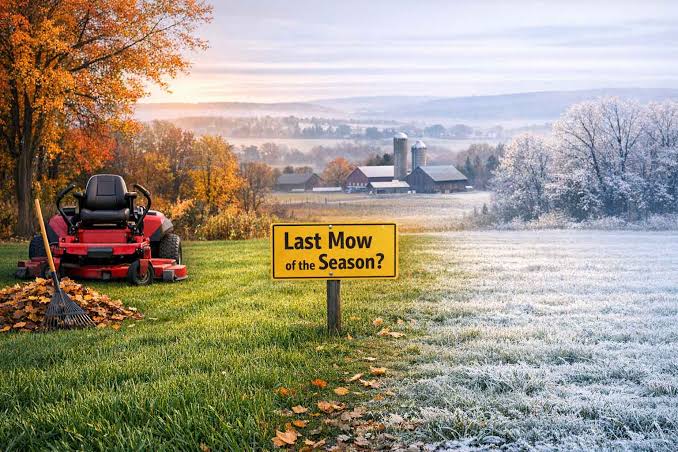
It is the middle of November, the leaves are mostly down, and the lawn still looks like it could use a cut. Or maybe it has not grown in two weeks and you are wondering whether that last pass was the last one. Knowing when to stop mowing the lawn is less about the calendar than about what the grass is doing, and in Connecticut the grass usually keeps going later than people expect.
Why the last mow matters
Cool-season grasses, which is what every lawn in Fairfield, Litchfield, and New Haven county is built on, do not shut down when the air gets cold. They slow. Top growth tapers off as soil temperatures fall through the 50s, but the roots keep working and the plant keeps moving energy into storage for spring green-up. The final mow sets the height the lawn will carry through four months of snow, ice, and thaw, and that height has consequences.
Leave the grass too long and it folds over and mats under the first heavy snow. Matted turf stays wet against the crown for weeks, which is exactly the condition snow mold wants, and it gives voles a roof to feed under all winter. Cut it too short and you expose the crowns to cold and drying wind, weaken the plant going into dormancy, and open the canopy for weeds to fill in the first warm week of April. The right height is in between, and getting there is a two or three cut process rather than one hard scalp.
How to tell it is time to stop
The grass tells you. Watch for these, roughly in the order they usually arrive:
- Daytime highs are consistently below about 50°F and nights are dropping to 32°F or lower.
- A week to ten days goes by and the lawn has not put on any height worth cutting.
- A hard frost has browned the blade tips and the color is shifting from deep green to a duller olive.
- The leaves are down. In our area the oaks finish last, and the final mow usually lands right after the oak drop ends.
How to spot it: Push a soil thermometer, or a long screwdriver with a thermometer alongside it, two to four inches into the turf in late afternoon. Once the soil holds under 50°F for several days in a row, the grass has effectively stopped growing above ground. Take the final cut then, while the blades are still dry and standing up, not after they have flopped under a wet snow.
In practical terms, that is usually late October into the first half of November in the Litchfield hills, and the second half of November along the shoreline towns of Fairfield and New Haven county. A mild autumn can push it into early December. A cold snap can end it in October. Mow as long as it is growing, and stop when it is not.
The right height for the final cut
Through the summer we keep lawns tall, three to three and a half inches, because the extra blade shades the soil and supports deeper roots. For the final mow, come down to about two and a half inches. Do not do it in one pass. Take a half inch off per cut over the last two or three mows so you never remove more than a third of the blade at once, which is the same rule that applies all season.
Two and a half inches is the balance point. It is short enough that the grass will not mat under snow, and tall enough that the crowns stay protected and the lawn still has leaf area working for it on sunny winter days. If you are not sure, err slightly taller. A lawn left at three inches recovers from a wet winter far better than one scalped to an inch and a half.
Fall cleanup checklist
The final mow is one item on a short list that all wants to happen in the same few weeks. Here is the order we work through on our own properties.
- Get the leaves off. A light scattering can be mulched in. A layer you cannot see grass through has to come off before the final cut. Our guide to leaf management covers how to tell the difference and how to mulch-mow properly.
- Finish the fall weed treatment while the weeds are still green. Late fall is the best broadleaf window of the year, because dandelion, clover, and ground ivy are pulling energy down into their roots and carry the treatment with them. Clear the leaves first so the application reaches the weed, and give it a few days before the final mow. See fall broadleaf weed control and our weed control program.
- Put down the last feeding. The final application of the year goes on while the grass is still green and the ground is not yet frozen, so the roots can take it up and store it. This is the feeding that drives spring green-up without a flush of soft growth. Our fall fertilization guide explains why it is the most important one, and our fertilization program covers how we time it.
- Take the final cut at two and a half inches. Sharp blade, dry grass, bag or mulch finely so no clumps are left sitting on the turf.
- Clear everything off the lawn. Hoses, furniture, toys, piles of leaves raked to the edge. Anything left on the grass for the winter leaves a dead patch in spring.
- Mark the plow line. If you have a driveway or walk that gets plowed, stakes along the edge keep the blade off the turf. Salt and plow damage along the edges is one of the most common spring repairs we see.
- Put the mower away properly. Run it dry or add stabilizer, clean the deck, and sharpen or replace the blade now so it is ready in April.
What the final mow does not fix
We will be plain about the limits. Taking the last cut at the right height reduces the risk of snow mold and vole damage. It does not rule either one out, because weather drives both. A winter with deep snow on unfrozen ground will produce some snow mold even on a well kept lawn, and our snow mold guide covers what to do when you find it in March.
The final mow also cannot thicken a thin lawn. If the turf went into November sparse, the window for seeding has closed. Seed put down now sits on cold soil and is more likely to wash, rot, or feed the birds than to establish. The fix is core aeration and overseeding in the proper window next year, and our guide to when to aerate and overseed explains why late summer is the right time, not spring and not now.
And if you left the grass at four inches and the snow arrived before you could get to it, do not go out and mow frozen or snow-covered turf. The damage from the mower outweighs the matting. Rake it up gently in spring instead.
How Pro Turf handles the end of the season
Whether you take the final cut yourself or a mowing crew does it, the treatments we apply are timed around it. The last broadleaf treatment goes down once the leaves are cleared and before the final cut. The final feeding goes down while the grass is still green and the ground is open. We read the trees and the soil temperature on each property rather than working to a fixed date, because a lawn under heavy oak in Woodbury and a lawn on the shoreline in Trumbull are on different clocks. See our lawn care program for how the full season fits together.
If you want a second opinion on how your lawn is set up heading into winter, or you want the fall treatments on the calendar for next year, Get a Quote and we will take a look.