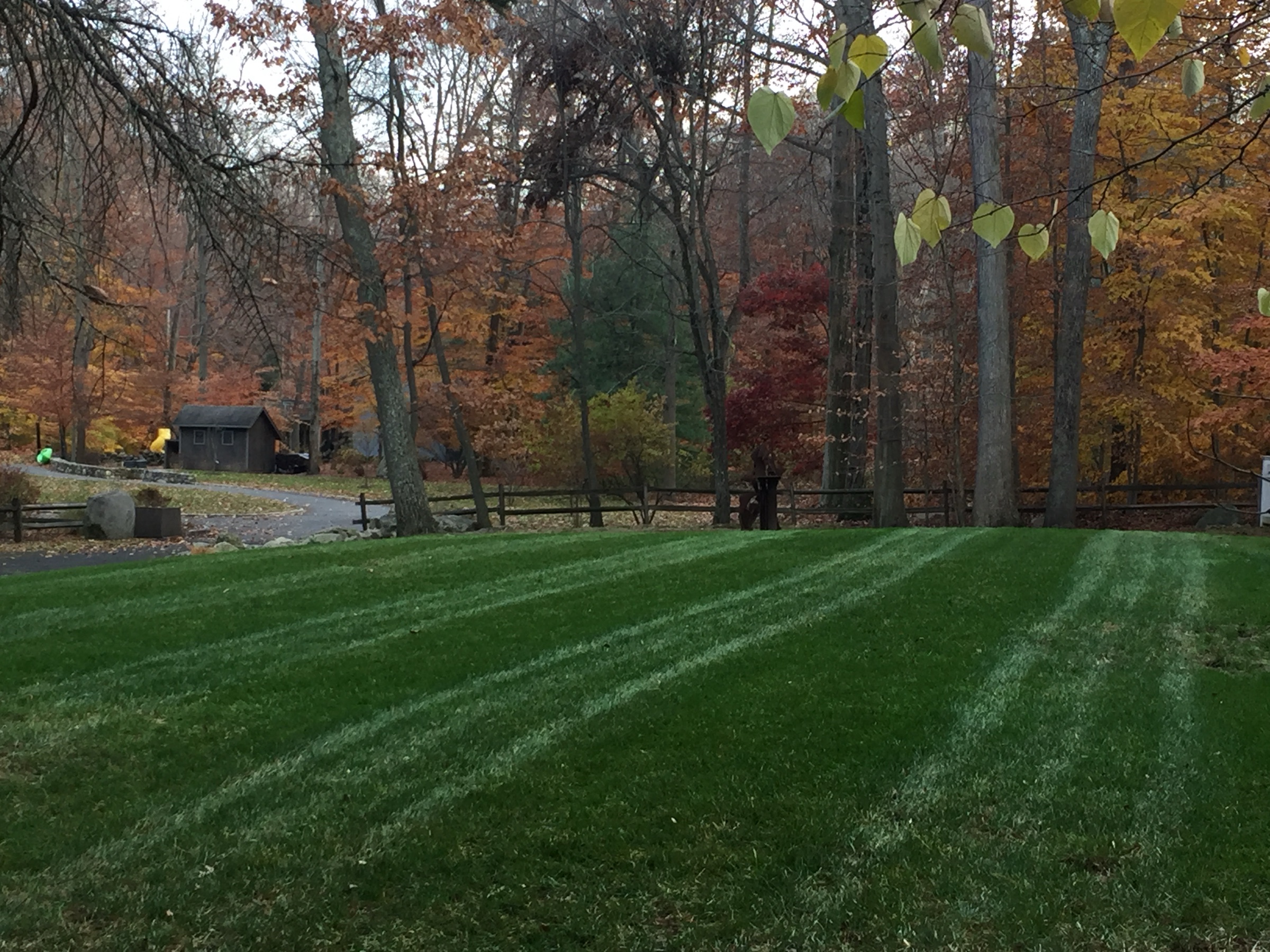
Lawn Health
Fall Lawn Fertilization: The Most Important Feeding of the Year
Fall is the most valuable feeding of the year for a Connecticut lawn. Why autumn fertilization beats spring, and when it needs to go down.
Fall is the most valuable feeding of the year for a Connecticut lawn. Why autumn fertilization beats spring, and when it needs to go down.
Thin or patchy turf that came out of summer worse than it went in and has not filled back on its own.
Pale or yellow-green color still lingering into September.
A lawn that greened up slowly and unevenly last spring — often a sign it went into winter with nothing stored.
Weeds moving into open ground, which is usually a density problem before it is a weed problem.
Any lawn aerated or overseeded this fall — new seedlings need feeding to establish before the cold.
Most homeowners think of lawn fertilization as a spring job. You watch the grass wake up, you want to push it along, so you feed it. That instinct isn't wrong — but it misses the most valuable feeding of the entire year. For the cool-season grasses that make up Connecticut lawns, autumn is when fertilizer does the most good. A lawn fed properly in fall looks better next May than one fed only in spring.
Kentucky bluegrass, fine fescue, tall fescue and perennial ryegrass — the grasses in nearly every Connecticut lawn — grow best when the air is cool and the soil is still warm. That is exactly what September and October give us. The heat and humidity are behind us, the lawn is recovering from weeks of stress, and conditions are close to ideal for the plant to rebuild.
The real difference is where the growth goes. In spring, a lawn pushes hard into leaf growth — you mow more often and the plant spends its energy above ground. In fall, top growth slows while the roots keep working. Feed the lawn then and the nutrients go into root development and into carbohydrate reserves stored in the crown of each plant. That is the fuel the lawn spends greening up next spring. You are not just feeding this year's grass; you are paying for next year's.
Through a hot Connecticut summer, a lawn spends more than it earns. Heat, drought stress, disease pressure and foot traffic all draw down the plant's reserves, and root systems shrink back. By late August most lawns are thinner than they were in June, even well-maintained ones.
Autumn reverses that. As soil temperatures ease out of the eighties, roots resume active growth and keep growing well after the grass above has stopped. That is the window fall fertilization is built around — a stretch of several weeks where the plant is actively taking up nutrients and putting them into storage rather than burning them on blade growth.
Fall is not one application. Done properly it is two, and they do different jobs.
Early fall, through September. This is the recovery feeding. It helps the lawn repair summer damage, thicken back up, and close the open space where weeds would otherwise establish. If you have aerated and overseeded, this feeding also supports new seedlings as they root in.
Late fall, from late October into November. This is the one most lawns never get, and it is arguably the most valuable application of the year. By this point top growth has essentially stopped — you have mowed for the last time or nearly so — but the roots are still active. Nutrients applied now go almost entirely into storage. The result shows up as a faster, more even green-up the following spring, without the surge of growth that a heavy spring feeding produces.
How to tell it worked: a lawn that got a proper late-fall feeding greens up earlier and more uniformly in spring, and it does it without the flush of soft, fast growth that makes a spring-fed lawn need mowing twice a week in May.
The dates above are a guide, not a rule. What actually governs fall feeding is soil temperature and how the season has run. A warm, wet October pushes the window later; an early cold snap closes it sooner. Inland Connecticut towns cool down ahead of the shoreline, so the same calendar date can mean two different things in Woodbury and in Milford.
The judgment call on the late feeding is getting it down while roots are still taking up nutrients but the grass has genuinely stopped growing. Too early and you push soft top growth heading into winter. Too late and the roots have shut down and the application does very little.
Autumn is also the right time for core aeration and overseeding in Connecticut, and the two practices reinforce each other. Aeration relieves compaction and opens the soil; overseeding puts new grass into that opening; fall feeding gives both the established turf and the new seedlings what they need to establish before winter. Doing one without the others leaves value on the table.
If you are overseeding this fall, read our guides on why aeration and overseeding work best together and how to care for new grass seed once it is down.
Fall fertilization is not a fix for everything, and more is not better. Over-applying nitrogen late in the season pushes lush, soft growth at exactly the wrong time, which can leave a lawn more vulnerable to snow mold over winter rather than less. The goal of the late feeding is root storage, not a green flush in December.
It also will not solve a problem that is not a nutrition problem. If a lawn is thin because of compacted soil, heavy shade, grub damage or a soil pH that locks up nutrients before the roots can use them, feeding it more will not fix the cause. We would rather identify what is actually limiting your lawn and tell you plainly than sell you an application that will not move the needle.
Fall feeding is built into our season-long lawn program rather than sold as a one-off. We use slow-release nitrogen and professional-grade products that are not available at retail, which means even, lasting color instead of a quick green flush that fades. Our licensed applicators time the fall applications to the season as it actually runs, not to a fixed date on a calendar — and because we are local, we are reading the same weather your lawn is.
Weed control is included as part of the program too. Fall is the best window of the year for treating broadleaf weeds like dandelion, clover and ground ivy, because they are actively moving nutrients down to their roots and carry the treatment with them. Feeding and weed control belong on the same schedule; you can read more about our approach to weed control or see the full fertilization program.
If your lawn came out of this summer thinner than you would like, fall is the season that turns it around. Request a quote and we will tell you what your lawn actually needs going into winter.
Our licensed team will identify it and build the right plan for your property across Fairfield, Litchfield & New Haven counties.
Request your quote →