Lawn Health
Leaves on Your Lawn: Mulch Them In or Clear Them Off?
A thin scattering of leaves can be mowed into a lawn. A packed wet layer does real damage. How to tell the difference, and when to clear instead of mulch.
A thin scattering of leaves can be mowed into a lawn. A packed wet layer does real damage. How to tell the difference, and when to clear instead of mulch.
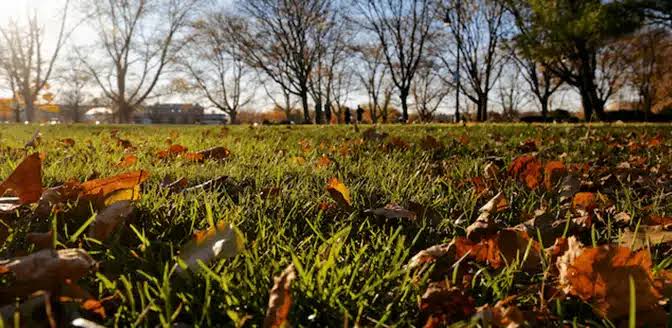
Every October the same question comes up on Connecticut lawns: do the leaves have to come off, or can you just mow them in? The answer is genuinely both, and the line between them is easier to see than most homeowners expect. A thin scattering mulched into the turf feeds the soil. A packed, wet layer left through November does real damage. Here is how to tell which one you have.
Late fall is when cool-season grass does its most valuable work. Top growth slows, roots keep going, and the plant moves energy into storage it will spend on green-up in April. All of that depends on the blades catching light. A matted leaf layer blocks it at exactly the wrong moment — the lawn stops earning right when it should be banking.
The second problem is moisture. Wet leaves press flat against the turf and hold water at the crown for weeks. That is the condition snow mold needs to establish, and it is why the matted gray and pink circles people find in March trace back to what happened the previous November. Clearing the leaves does not guarantee you will not see it — conditions drive disease outcomes — but it removes one of the main things working in its favor.
Third, a leaf mat gives voles cover. They tunnel and feed underneath it all winter, and you find the runways when the snow comes off.
How to spot the line: after you mow, look straight down. If you can see grass blades through the chopped leaf pieces, you are fine — that will break down and feed the soil. If the leaves form a continuous blanket you cannot see turf through, it is too much to mulch and needs to come off.
Roughly speaking, a layer you can still see grass through is working for you. Anything approaching an inch of packed leaf is working against you.
Mulching leaves into a lawn is not just running the mower over them once. Done right it returns organic matter and a little nitrogen to the soil, and it is less work than raking.
Much of Fairfield, Litchfield, and New Haven county sits under mature oak, and oak behaves differently from maple or birch. Oak leaves are leathery, slow to break down, and they drop late — often holding on well into November after everything else has finished. That is an awkward combination: the heaviest, most persistent leaf arrives in the narrowest part of the season, when there is the least time left before the ground freezes.
Maple drops earlier and lighter but mats faster once it is wet. On a property with both, the practical approach is to mulch through the early maple drop and plan on clearing the oak.
Leaf work sits alongside a short list of things that all want to happen in the same few weeks.
Drop the final cut a little lower — around two and a half inches — so the grass is less likely to mat under snow. Get the last feeding down while roots are still active; our guide to fall fertilization covers that timing. And if the lawn has thinned, this is the tail end of the window for aeration and overseeding, though earlier is considerably better than later.
Fall is also the best broadleaf weed window of the year, because perennial weeds are pulling energy down into their roots and carry a treatment with it. Leaves matter here too — you cannot treat what is buried, so clearing the lawn is what makes the application possible. Our guide to fall broadleaf weed control covers which weeds are worth targeting, and you can see our weed control program for how we handle it.
Leaf removal is not a lawn treatment, and it will not fix a lawn with other problems. If your turf is thin because of compacted soil, heavy shade under that same oak canopy, or a soil pH that is locking up the fertilizer you are already paying for, clearing leaves will not change any of it. It will only stop one more thing from making it worse.
The shade point is worth naming plainly: some spots under a dense hardwood canopy will never hold a thick stand of grass no matter how well they are managed. It is better to know that than to keep spending against it.
We time the last feeding and the fall weed control around leaf drop rather than around a date, because a lawn buried in oak leaves cannot be treated properly, and a lawn cleared too early misses the window on the other side. Reading the canopy is part of the job.
If you are not sure whether what is sitting on your lawn right now can be mowed in or needs to come off, we can tell you. Request a quote and we will look at the lawn and the trees over it, and put together a plan for the rest of the season.
Our licensed team will identify it and build the right plan for your property across Fairfield, Litchfield & New Haven counties.
See our lawn care programRequest your quote →