Lawn Health
Slice Seeding vs. Overseeding: Which Does Your Lawn Need?
Slice seeding and overseeding both add grass — but only one of them fixes the compacted soil underneath. Here's why we recommend aeration and overseeding.
Slice seeding and overseeding both add grass — but only one of them fixes the compacted soil underneath. Here's why we recommend aeration and overseeding.
When a lawn needs more grass, there is more than one way to get seed into the ground. The two approaches you will hear about most are overseeding — paired with core aeration — and slice seeding, sometimes called slit seeding. Both put down new grass. Here is what each actually does, and why we recommend one of them for Connecticut lawns.
Overseeding spreads seed across the existing lawn, and when it is paired with core aeration, that seed settles into freshly opened soil for direct contact. This is the approach we recommend, and it is what we do.
The reason is that it solves two problems in one visit rather than one. Slice seeding puts seed in the ground, but it does nothing about compaction — and on Connecticut's heavy clay soils, compaction is usually the reason the lawn thinned out in the first place. Seeding a compacted lawn gets you germination without fixing the cause, and the new grass runs into the same hard ground the old grass struggled in. Core aeration relieves the compaction and creates the seedbed at the same time, so the new seed comes up into soil that can actually support it. Our aeration and overseeding guide covers the pairing in full.
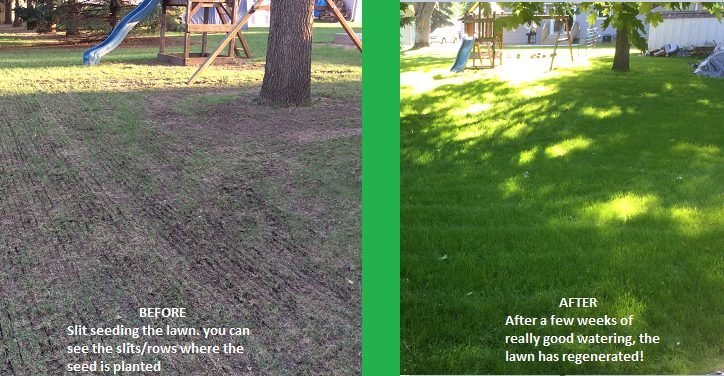
Slice seeding uses a machine that cuts shallow grooves into the soil and drops seed directly into those slits, placing seed in firm contact with soil at a consistent depth. It is a legitimate method and it achieves good germination — seed placement is its strength.
Its limitation is what it leaves undone. The grooves are narrow and the machine does not relieve compaction across the lawn the way core aeration does. It also disturbs the existing turf more than aeration, cutting through healthy grass along with the thin areas.
The short version: slice seeding places seed well but does not fix compacted soil. Core aeration and overseeding places seed well and relieves the compaction underneath. On Connecticut clay, that second half is usually the whole problem — which is why we recommend aeration and overseeding.
For lawns that are significantly bare or being heavily renovated, the instinct is to reach for the most aggressive seeding method available. In our experience that is still not the right call here. A badly thinned lawn on compacted clay needs the compaction addressed more than it needs deeper seed placement — and where coverage is the concern, aeration and overseeding with a heavier seeding rate and a follow-up pass gets there without leaving the underlying soil problem in place.
If a lawn is genuinely beyond seeding — more bare ground than grass — that is a renovation conversation, not a seeding-method conversation, and we will tell you that honestly rather than seed over a problem.
Both methods follow the same Connecticut calendar — the late-August-through-September fall window, when warm soil and cooling air give new grass its best start. And both live or die on the same aftercare: keeping new seed consistently moist through germination, as laid out in our overseeding aftercare guide.
Not sure what your lawn actually needs? That judgment call is exactly what an assessment answers. Pro Turf Lawn Care evaluates lawns and performs core aeration and overseeding across Fairfield, Litchfield, and New Haven counties each fall. Request your online quote here.
Our licensed team will identify it and build the right plan for your property across Fairfield, Litchfield & New Haven counties.
See our aeration & overseeding serviceRequest your quote →