Disease
Lawn Rust: Orange Powder on Grass Blades and Shoes
Orange dust on your shoes and mower after a late-summer mow is lawn rust. What causes it, why it signals a slow-growing lawn, and how to grow out of it.
Orange dust on your shoes and mower after a late-summer mow is lawn rust. What causes it, why it signals a slow-growing lawn, and how to grow out of it.
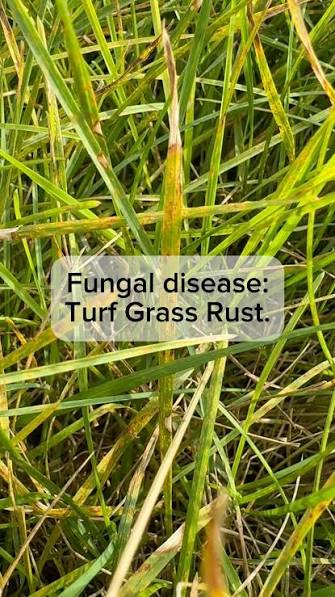
You walk across the lawn in late August and your sneakers come back orange. Run the mower and the wheels and deck are dusted the same rusty color. Kneel down and the blades themselves look flecked with orange-yellow powder that rubs off on your fingers.
That is lawn rust. It looks alarming, and it is usually the mildest turf disease we deal with all season. What rust really tells you is that your lawn has stopped growing — and that part is worth paying attention to.
Rust is a fungal disease caused by Puccinia species. It infects the leaf blade and produces spores in small raised pustules that break through the surface of the leaf. Those spores are the orange powder. They are loose, they travel on shoes, pets, mower tires and wind, and they are what makes rust so obvious even when the actual damage is minor.
Perennial ryegrass and Kentucky bluegrass are the most susceptible grasses, and both are common in lawns across Fairfield, Litchfield and New Haven counties. Newly seeded areas and lawns with a high ryegrass percentage usually show it first.
Rust is one of the easier lawn problems to identify with confidence, because the confirmation test takes about three seconds.
How to spot it: Pull a handful of blades from a yellowed area and draw them across a white tissue or the palm of your hand. If you get an orange-to-rust-colored smear, it is rust. Nothing else on a Connecticut lawn leaves that mark. Look closely at a single blade and you will see the pustules themselves — small raised orange-yellow specks arranged in rows along the length of the leaf.
From standing height, rust reads as a general yellow-orange haze over an area rather than a defined patch. That vagueness is a useful clue on its own: dollar spot throws small silver-dollar patches with a banded lesion across the blade, and red thread puts fine pink threads out past the blade tips. Rust does neither. It just tints things.
Rust needs two things at once: a long stretch of leaf wetness, and grass that is growing too slowly to shed the infection.
Connecticut delivers both in late summer. By mid-August the nights are cooling, dew sits on the lawn until nine or ten in the morning, and the grass is coming off a hot, dry stretch with its growth rate way down. Rust has a window from roughly August into October, and it is worst in the years when September rain arrives after a droughty August.
Slow growth is the real driver. A healthy blade of grass carries the infection for a few days and then gets mowed off before the spores do much. When the lawn is barely growing, that same blade stays on the plant long enough for the pustules to mature and spread. That is why rust concentrates in the places where growth is slowest: shaded areas under trees, lawns that have not been fed since spring, compacted ground, and unirrigated turf that spent August dormant.
Newly seeded lawns are a special case. Young seedlings grow slowly and are often heavy on perennial ryegrass, so a fall seeding put down in early September will frequently pick up rust by early October. It looks bad on brand-new grass, but it rarely costs you the seeding.
Feed the lawn. That is the whole treatment on most properties. A nitrogen application restores growth rate, the infected tissue gets mowed off, and the new growth coming in behind it is clean. Rust is one of the few lawn diseases where the fix is to make the grass grow rather than to spray something on it.
The rest is ordinary good practice. Water deeply and early in the day so the blades dry before evening — light evening watering is the single easiest way to extend the wetness window rust needs. Keep mowing on schedule, and bag or blow the clippings while rust is active so you are carrying spores off the lawn rather than around it. Sharpen the blade. Where shade is the underlying cause, thinning tree limbs to move air and light does more than any product will.
Fungicide is almost never warranted for rust on a home lawn. We say that plainly because it is true, and because you are better served spending that money on the feeding that fixes the actual problem.
Rust is a foliar disease. It damages leaf tissue but does not attack the crown or the roots, so it does not kill turf. Once the lawn is fed and growing, it grows out. Persistent rust year after year is not a disease problem — it is a fertility, shade or compaction problem announcing itself in an unusually visible way.
No program can promise that rust will not appear. Conditions drive it, and a wet, cool September will bring it out on well-managed lawns too. What a consistent feeding schedule does is keep the lawn growing fast enough that rust reduces to a cosmetic nuisance for a couple of weeks rather than a season-long haze. It also keeps the turf dense, which is the same thing that keeps weeds out — the two go together, which is why our weed control and feeding sit on one schedule. You can read more about how we handle weed control.
When we find rust on a Connecticut lawn in September, the first move is almost always a feeding, not a spray. Fall is the strongest fertilization window of the year here anyway, so the treatment for rust and the most valuable application on the calendar happen to be the same thing — our guide to fall lawn fertilization covers why. We use slow-release nitrogen and professional-grade products that are not sold at retail, applied by licensed technicians on timing that follows the season rather than a fixed date.
If we look at the lawn and conclude that shade or compaction is what is really holding growth back, we will tell you that instead of selling you an application that will not move the needle.
Orange dust on your shoes after every mow? Request a quote and we will confirm it is rust and treat what is causing it.
Our licensed team will identify it and build the right plan for your property across Fairfield, Litchfield & New Haven counties.
See our fertilization programRequest your quote →