Disease
Dollar Spot in Connecticut Lawns: Spotting It & Stopping It
Dollar spot lawn disease in Connecticut leaves small silver-dollar patches. How to identify it, why it signals hungry turf, and how to stop it spreading.
Dollar spot lawn disease in Connecticut leaves small silver-dollar patches. How to identify it, why it signals hungry turf, and how to stop it spreading.
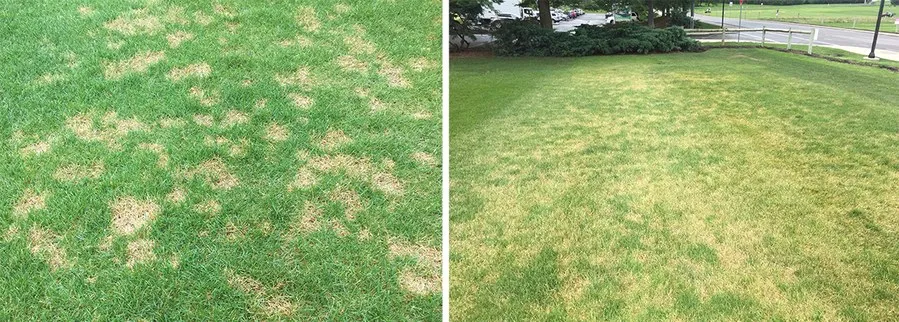
Small straw-tan spots two to three inches across - roughly the size of a silver dollar.
Bleached band across the blade with a reddish-brown border on each side (hourglass lesion).
Fine white cobwebby mycelium on the spots at dawn, gone by mid-morning.
Spots merge into larger irregular blotches if left untreated.
Shows up on hungry, under-fertilized turf - the opposite of brown patch.
Dollar spot is the disease that makes a homeowner think they have a bug problem. Small, round, straw-colored spots about the size of a silver dollar appear scattered across the lawn, and if you ignore them they merge into larger blotches. It is one of the most common turf diseases we treat across Fairfield, Litchfield, and New Haven counties — and dollar spot lawn disease in Connecticut is unusual in that the fix often has less to do with fungicide than with feeding the lawn properly.
Dollar spot is caused by a fungus (Clarireedia, formerly lumped in with Sclerotinia) that lives in the thatch layer. It becomes active from roughly late May through September, and it is happiest in exactly the weather Connecticut delivers all summer: warm days in the 70s and 80s, cool nights, and heavy dew that sits on the blades until mid-morning.
Start with the size and shape. The spots are small — two or three inches across, roughly circular, and bleached straw-tan. That alone separates it from brown patch, which throws patches a foot or more wide. The real confirmation is on the individual blade.
How to spot it: Pull a blade from the edge of a spot. Dollar spot leaves a bleached, straw-white band straight across the blade with a distinct reddish-brown border on each side — often described as an hourglass lesion. Early in the morning, before the dew burns off, you may also see fine white cobwebby mycelium sitting on top of the spots. That mycelium vanishes by mid-morning, so look early.
Dollar spot is a hunger disease. It attacks turf that is short on nitrogen. That is the opposite of brown patch, which is made worse by too much nitrogen — and it is exactly why guessing between the two costs you. If you starve a lawn to avoid brown patch and dollar spot is what you actually have, you make it worse. Adequately fed turf grows fast enough to outpace the infection and simply mows the damage off.
Low nitrogen is the main driver. After that: extended leaf wetness from evening watering or heavy dew, drought stress on lawns that are underwatered, and a thick thatch layer that harbors the fungus. Light, frequent watering is a particularly common mistake — it keeps blades damp without ever getting moisture down to the roots.
Feed the lawn. A balanced nitrogen application is often the whole treatment, and on a lot of properties it is all we do. Water deeply and infrequently, early in the morning, so the blades dry quickly. Knocking the dew off in the morning — a hose drag or even just mowing — shortens the wetness window the fungus needs. Keep the mower blade sharp, since ragged cuts give the fungus an easier entry. For lawns with a heavy history, a preventive fungicide before symptoms show is far more effective than chasing spots after they appear.
Yes, in most cases. Dollar spot damages leaf tissue rather than killing the crown, so once the turf is fed and the weather cooperates, it grows out. Persistent spots year after year are a signal that the fertility program is not keeping up — and that is a fixable problem, not a permanent one. If you are not sure whether what you have is dollar spot, red thread, or something else entirely, our bare and brown spots guide lays out the differences.
Seeing small straw-colored spots multiplying across your lawn? Request a quote and we will confirm what it is and treat the cause, not just the symptom.
Our licensed team will identify it and build the right plan for your property across Fairfield, Litchfield & New Haven counties.
See our disease treatment programRequest your quote →