Lawn Health
Lawn Thatch: When to Worry and How to Fix It
Lawn thatch is normal until it isn't. How to measure yours, what causes buildup, and the honest fix for a spongy Connecticut lawn.
Lawn thatch is normal until it isn't. How to measure yours, what causes buildup, and the honest fix for a spongy Connecticut lawn.
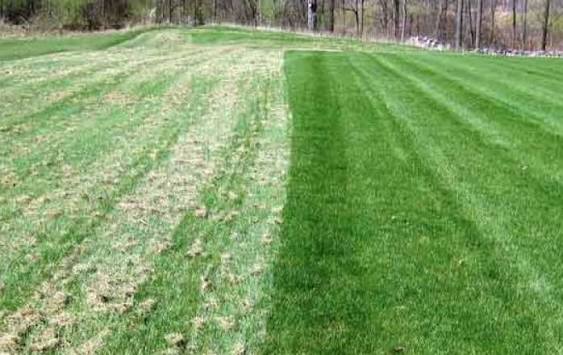
The lawn feels different underfoot. Springy, almost like walking on carpet padding. You water it and the water sits on top for a moment before it goes anywhere, and after a dry week the grass browns faster than it used to even though nothing else changed. Pull back a handful of blades and there it is - a tan, matted layer sitting between the green grass and the soil.
That layer is thatch, and the first thing worth saying is that a little of it is supposed to be there. Thatch only becomes a problem at a specific thickness, and most of the lawns we are called out to look at in Newtown, Monroe, Trumbull, Southbury and Woodbury do not actually have a thatch problem. They have a compaction problem that feels like one. Knowing which you have changes what you should spend money on.
Thatch is a layer of living and dead organic matter that collects between the soil surface and the green growth above it. It is made mostly of the tough, slow-rotting parts of the grass plant - stems, crowns, stolons and roots. Lignin-rich tissue takes a long time to break down, which is why it accumulates.
Grass clippings are not what causes it. That is the most persistent myth in lawn care, and it costs homeowners real money in bagging and hauling. Clippings are mostly water and soft leaf tissue; they decompose within a couple of weeks and return nitrogen to the lawn. Leaving them is good practice, not the cause of your problem.
Under half an inch, thatch is doing you favors. It insulates the crown of the plant against temperature swings, holds moisture at the surface, and cushions foot traffic. Past about three quarters of an inch it starts working against the lawn, and past an inch it is actively causing damage.
How to spot it: Cut a small wedge out of the lawn with a spade, three or four inches deep, and lift it out like a slice of cake. Look at the side of the wedge. You will see green grass on top, then a distinct tan-brown fibrous band, then darker soil below. Put a ruler on that tan band. Under half an inch is healthy and needs nothing. Half to three quarters is worth watching. Over three quarters of an inch is a genuine thatch layer. Take the wedge from two or three different areas - thatch is rarely even across a property, and the answer for the front lawn is often not the answer for the back.
While you have the spade in the ground, do the second test. Push a screwdriver straight down into the soil below the thatch. If it slides in six inches without much effort, your soil is fine and thatch is the story. If it stops in the first two inches, you are looking at compacted soil, and that is a different problem with a different fix.
Thatch accumulates when the grass produces organic matter faster than soil microbes can break it down. Several things here tip that balance.
Once the layer passes about three quarters of an inch, the grass starts rooting into the thatch itself instead of the soil. Thatch dries out far faster than soil does, so those roots have no reservoir to draw on - which is why a thatchy lawn is usually the first one to brown in a July dry spell despite being watered.
It also intercepts what you put down. Water beads and runs off, and fertilizer and control products get bound up in the organic layer before they reach the root zone. And because a thick mat holds moisture against the crowns overnight, it gives fungal disease exactly the conditions it likes. Thin, stressed turf then gives weeds an opening, which is why weed pressure and thatch so often show up on the same lawn - our weed control program handles the weeds, but the thatch and compaction underneath are what let them in.
Core aeration is the answer for the great majority of lawns. Pulling plugs out of the ground does three things at once: it relieves the compaction underneath, it opens channels for oxygen so the decomposing microbes can get to work, and it drops soil cores onto the surface where they mix into the thatch and inoculate it with those microbes. That biological breakdown is slower than a machine, but it addresses the cause rather than the symptom, and it does not tear the lawn apart. Our core aeration guide covers how it works in more detail.
Correct what caused it. Aeration on a lawn still getting heavy quick-release nitrogen just buys you a few seasons before you are back where you started. Move to slow-release feeding at sensible rates, water deeply and less often rather than lightly every day, and get a soil test done - if pH is low, lime brings the microbial population back and the thatch starts breaking down on its own.
Overseed the same day. A thatchy lawn is usually a thinning lawn, and freshly aerated soil is the best seedbed you will get. Doing both in one visit is why aeration and overseeding are paired.
Pro Turf does not offer dethatching, and we would rather tell you that plainly than dress it up. Power raking is genuinely the right call for a small number of lawns carrying an inch or more of thatch, and if that is what your lawn has, we will say so and tell you to bring in someone who does that work. It is not a service we provide.
What we will not do is sell you a mechanical dethatching for a half-inch layer that is doing its job. Power raking is hard on a lawn - it tears out a meaningful share of the healthy turf along with the thatch, and it leaves the surface open for weed seed. On the lawns where thatch measures under three quarters of an inch, which is most of them, aeration and a corrected feeding program will get you there without the damage.
If you are unsure whether your lawn is fighting thatch, compaction, or both, the difference between the two is easy to sort out with a spade in hand. We also cover the distinction side by side in dethatching vs. aeration.
When we walk a property we cut a wedge and measure the layer before recommending anything, because the number decides the plan. Where thatch is within normal range and the soil is tight, core aeration in the late-August to October window is what we schedule, paired with overseeding so the lawn thickens as the layer breaks down. Slow-release feeding through the season keeps the balance from tipping back, and if a soil test comes back acidic we will get lime on the schedule.
Where a lawn is genuinely carrying an inch or more, we will tell you that dethatching is the right call and that it is not work we do. Naming the limit is part of giving you an accurate answer.
If your lawn feels spongy underfoot and water is sitting on the surface, this is the season to sort it out. Request a quote and we will come out, measure what is actually there, and tell you what it needs.
Our licensed team will identify it and build the right plan for your property across Fairfield, Litchfield & New Haven counties.
See our aeration & overseeding serviceRequest your quote →