Disease
Summer Patch in Connecticut Lawns: Heat-Stress Rings & Root Rot
Summer patch lawn disease in Connecticut kills roots, not leaves. Why the rings appear in July heat, and why watering harder will not fix it.
Summer patch lawn disease in Connecticut kills roots, not leaves. Why the rings appear in July heat, and why watering harder will not fix it.
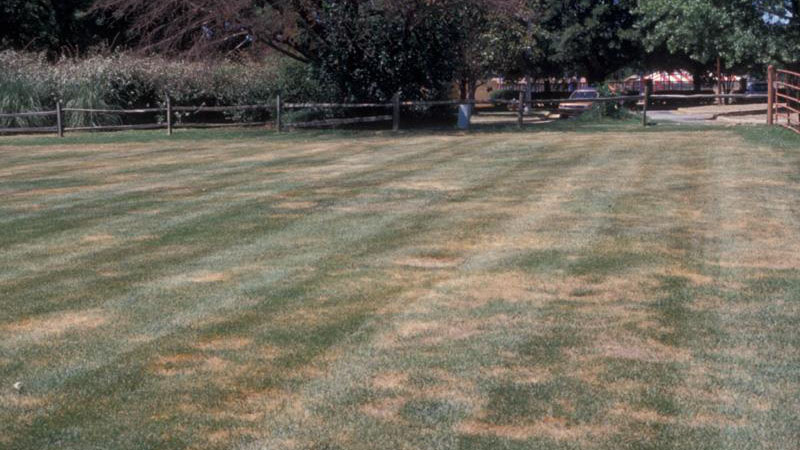
Rings, arcs and crescents six inches to two feet across, often with living grass in the center.
Plants at the ring edge pull out with almost no roots.
Crowns and stems below the soil line look dark brown or black and rotted, not white.
Appears in the July and August heat, but the infection started back in late spring.
Worst on compacted, full-sun ground and on Kentucky bluegrass and fine fescue.
Summer patch is the disease that punishes you for guessing. Rings and crescents of dead grass appear in the July heat, the lawn looks thirsty, so the homeowner waters harder — and it gets worse. That is because summer patch lawn disease in Connecticut is not a leaf problem at all. By the time you see it, the roots are already gone, and more water cannot reach a plant that has nothing left to drink with.
Summer patch is caused by Magnaporthe poae, a fungus that infects and destroys roots, crowns, and the stems below the soil line. It is a root rot wearing the costume of heat stress. The plant is not wilting because it is dry — it is wilting because its root system has been eaten and it can no longer take water up, no matter how much you put down.
Here is the part that catches almost everyone. Infection begins in late spring, once soil temperatures at the root zone hold around 65°F — often in May here in Connecticut. Nothing shows on the surface. The fungus quietly works through the root system for weeks. Then the first serious heat of July arrives, the damaged roots cannot keep up with demand, and the lawn collapses in rings seemingly overnight.
So the symptoms and the cause are separated by a month or more. That gap is the whole reason summer patch is treated the way it is: preventively, in late May and June, long before anything looks wrong.
Look at the shape. Summer patch throws rings, arcs, crescents, and frog-eye patterns — circles of dead or straw-colored turf that often have seemingly healthy grass surviving in the middle. That doughnut is characteristic. Kentucky bluegrass and fine fescue are the most susceptible; it hits hardest on compacted ground, in full sun, on south-facing slopes, and where soil pH is on the high side.
How to spot it: Look for rings and crescents six inches to a couple of feet across, often with a tuft of living grass in the center. Then dig. Tug a plant from the edge of the ring — if it pulls out with almost no root system, and the crown and stem below the soil line look dark brown or black and rotted, that is summer patch. Healthy roots are white and firm. This is the test that separates it from drought stress, which leaves roots intact.
Drought browning is uniform and the roots stay white and healthy. Brown patch throws large solid circles and damages leaf blades, not roots, and the turf stays rooted down. Grub damage also destroys roots, but the sod peels back in sheets and you will find white C-shaped larvae in the top inch of soil — summer patch leaves no insects, just black, rotted stems. Our bare and brown spots guide covers the full set of look-alikes.
Prevention is the whole game. Fungicide applied in late May into June — when soil temperatures cross into the infection window — is effective. The same product sprayed in July, after the rings appear, is largely wasted, because the roots it was meant to protect are already gone.
Beyond spraying, the cultural fixes are real: relieve compaction so roots can breathe, avoid mowing too short (never scalp a lawn in summer heat), water deeply and infrequently rather than lightly and often, and keep soil pH from drifting high — a soil test tells you where you stand. Over the long run, overseeding with more resistant grass types reduces how hard it hits.
Damaged areas do not bounce back the way leaf-spot diseases do, because the plants in those rings are dead rather than injured. Those areas need seed, and Connecticut's late-August-through-September window is when to do it. If summer patch has shown up on your lawn once, plan on the preventive application next spring — it tends to return to the same spots year after year.
Seeing rings of dead grass with green centers in the July heat? Request a quote and we will check the roots before you waste another month watering.
Our licensed team will identify it and build the right plan for your property across Fairfield, Litchfield & New Haven counties.
See our disease treatment programRequest your quote →