Pest
Japanese Beetles in Connecticut Lawns: ID, Damage & Control
Those metallic-green beetles chewing your plants become next year's grubs. Here's how to identify Japanese beetles in Connecticut lawns and control them.
Those metallic-green beetles chewing your plants become next year's grubs. Here's how to identify Japanese beetles in Connecticut lawns and control them.
Every summer, right around the time Connecticut lawns hit their stride, a shimmering, metallic-green beetle shows up and starts chewing through the garden. Japanese beetles are one of the most recognizable pests we deal with, but most homeowners don't realize the insect skeletonizing their roses is the same one setting up next year's lawn grub problem. Understanding that connection is the key to controlling Japanese beetles before they do damage on two fronts.
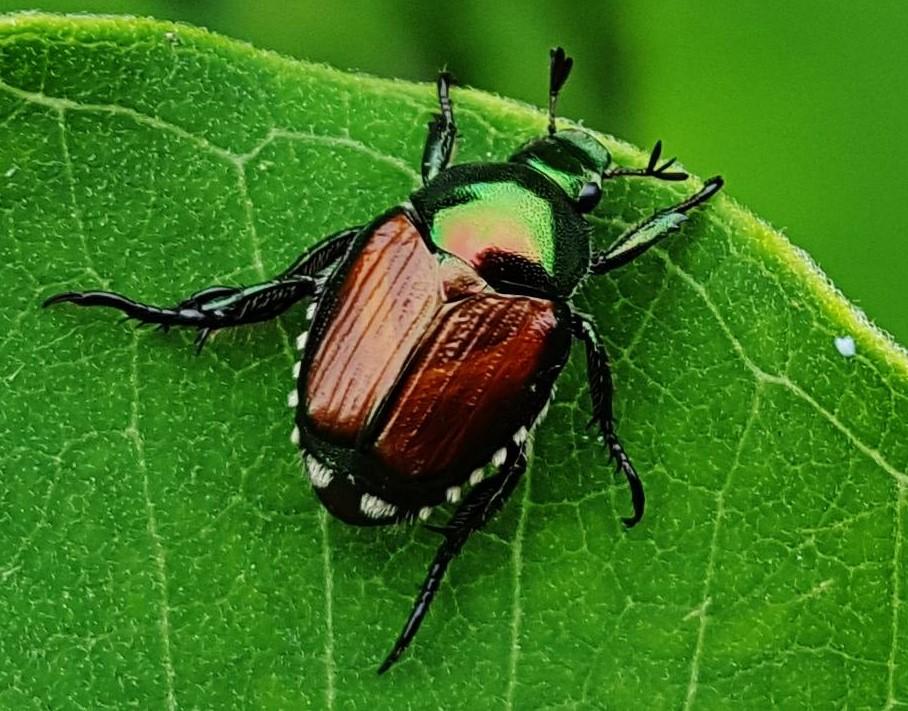
The adult is about a half-inch long, with a bright metallic-green head and body and coppery, bronze-colored wing covers. The surest way to tell a Japanese beetle from the look-alikes is a row of small white tufts of hair along each side of the abdomen, just under the edge of the wing covers. They're strong, clumsy fliers, active on warm sunny days, and they tend to feed in groups — one beetle releases scents that draw in more, which is why an infestation can seem to explode over a few days.
Japanese beetles cause trouble at two completely different life stages, in two different parts of your yard. As adults, from roughly late June through August, they feed on the leaves and flowers of hundreds of plants — roses, lindens, birches, fruit trees, and many ornamentals are favorites. They eat the soft tissue between the veins, leaving a lacy, skeletonized leaf behind.
The lawn damage comes later and underground. Through mid- to late summer, the adult females burrow into turf to lay their eggs, and those eggs hatch into white grubs — the same C-shaped larvae that chew grass roots and leave patches that peel up like loose carpet in late summer and fall. In other words, a heavy population of adult beetles feeding and laying eggs in June and July is a direct preview of a grub problem in August and September.
Japanese beetles are well established across Fairfield, Litchfield, and New Haven counties, and they favor exactly the conditions our area offers: sunny, irrigated, well-kept lawns make ideal egg-laying sites, because moist soil keeps the eggs and young grubs alive. That's the frustrating irony — the lush, watered lawn you've invested in is prime real estate for egg-laying. Neighborhoods with lots of the beetles' preferred ornamental plants tend to see the heaviest pressure, since the adults feed nearby and lay eggs in the closest good turf.
How to spot it: Look for half-inch beetles with a metallic-green body and copper-bronze wing covers, clustered on plant leaves and flowers on warm, sunny days — with a row of small white hair tufts along the sides of the abdomen. The plant damage is distinctive too: leaves eaten down to a lacy skeleton between the veins, while the veins themselves are left intact. Seeing lots of adults in June and July is your early warning that grubs may follow in the turf later in the season.
Because Japanese beetles do damage as both adults and grubs, the smartest control looks at the whole cycle rather than just the beetles you can see. On the lawn side, the most reliable move is a properly timed preventive grub treatment applied before the eggs hatch, so the next generation is controlled in the soil before it can damage roots — which also chips away at the following year's beetle population. For the adults, targeted plant protection during their feeding window helps shield valuable ornamentals. One thing we steer homeowners away from is the store-bought beetle trap: the scented lures are so effective at attracting beetles that they typically pull in far more than they catch, drawing extra egg-laying pressure right into your yard.
Japanese beetles are predictable, and that's exactly what makes them manageable — if you get ahead of the calendar instead of reacting to the damage. Pro Turf Lawn Care tracks the beetle pressure and the soil conditions across Fairfield, Litchfield, and New Haven counties, and builds grub prevention into the seasonal program at the point where it actually works. If you're seeing metallic-green beetles on your plants now, or you've had grubs peel up your lawn in past falls, it's worth getting a plan in place before the next generation settles in. Request your online quote here.
Our licensed team will identify it and build the right plan for your property across Fairfield, Litchfield & New Haven counties.
See our fertilization & grub control programRequest your quote →