Disease
Fairy Ring in Connecticut Lawns: Rings, Mushrooms & How to Control It
Those dark green rings and clusters of mushrooms in your Connecticut lawn are fairy ring. Here's how to identify it — and the cultural fixes that control it.
Those dark green rings and clusters of mushrooms in your Connecticut lawn are fairy ring. Here's how to identify it — and the cultural fixes that control it.
If a dark green circle — or a ring of mushrooms — has appeared in your Connecticut lawn seemingly overnight, you're looking at fairy ring, one of the stranger-looking problems we get called out for. Fairy ring and its lawn mushrooms tend to show up after a warm, wet stretch, and the ring can be unsettling on a yard you've worked hard to keep even. The reassuring part: fairy ring is almost never the emergency it looks like, and once you understand what's feeding it underground, it becomes far easier to manage.
Fairy ring isn't an insect or a weed — it's the visible signature of fungi living in the soil beneath your lawn. Dozens of different soil fungi can cause it, and they all do the same basic thing: they feed on decaying organic matter in the ground — old thatch, buried roots, a stump ground out years ago, or construction debris left under the sod. As the fungus grows, it spreads outward from a central point in an expanding circle, which is why the symptoms form rings and arcs rather than random patches. The mushrooms, when they appear, are simply the fruiting bodies of that underground fungus pushing up to release their spores.
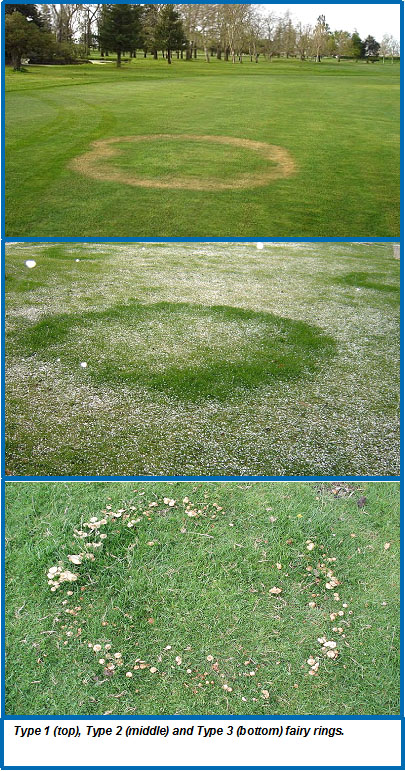
Fairy ring doesn't always look the same, and Connecticut lawns show all three of its forms. The first is a ring of lush, dark green grass that grows faster than everything around it. The second is a ring of thin, brown, or dead-looking grass. The third is a ring of mushrooms or puffballs with little change to the grass itself. You may even see two of these at once — a dark green band with mushrooms scattered along it after rain.
The dark green comes from nitrogen. As the fungus breaks down organic matter, it releases nitrogen into the soil, and the grass over that zone greens up and surges. The brown, dying rings are the opposite problem: some of these fungi weave a dense, water-repellent mat of threads through the soil, and that mat keeps rain and irrigation from soaking in. The grass above it isn't diseased at all — it's simply drought-stressed, dying of thirst even when the rest of the lawn is getting plenty of water.
Fairy ring favors soils rich in organic material, so it's especially common on newer lawns built over buried construction debris, on properties with old tree roots or removed stumps breaking down underground, and on lawns carrying a heavy thatch layer. Warm soil and moisture trigger it, which is why we see the rings and the flush of mushrooms most from late spring through fall — and almost always in the days after a soaking rain or a humid, wet stretch. Both sandy, fast-draining soils and lawns that stay damp tend to see more of it. Once a fairy ring is established, its underground network can persist for years, expanding a little wider each season.
How to spot it: Look for a circle or arc — anywhere from a foot to many feet across — rather than an irregular patch. Tell-tale signs are a band of unusually dark green, fast-growing grass, a ring of thin or browned-out turf, or a scattering of mushrooms or puffballs, often appearing after rain. If a browned ring resists watering, push a screwdriver into the soil beneath it: dry, hard-to-penetrate ground that repels water points to the water-repellent fungal mat behind fairy ring.
The fairy ring fungus itself won't kill a healthy lawn — the damage is almost always cosmetic. The mushrooms are a different consideration. Many lawn mushrooms are toxic if eaten, so if you have children or pets who spend time in the yard, it's worth knocking the mushrooms down and removing them promptly. Raking or mowing them off doesn't cure the fairy ring — the fungus lives in the soil, not in the mushroom — but it removes the risk and tidies the lawn while you address the conditions underneath.
Here's the honest part: fairy ring is one of the harder lawn problems to eliminate outright, because the fungus lives deep in the soil where fungicides reach it poorly. For most Connecticut lawns, the smarter goal is to manage and mask it rather than chase eradication. The single most useful step is core aeration through the affected area, which breaks up that water-repellent layer and lets moisture and nutrients reach the roots again. Pairing aeration with deep, thorough watering — sometimes with a wetting agent to help rehydrate the hydrophobic zone — revives the drought-stressed rings. For the dark green rings, a balanced fertilization program is the quiet fix: feeding the whole lawn evenly brings the surrounding turf up to match the stimulated ring, so the circle blends away instead of standing out. Reducing thatch and, in stubborn cases, removing the pocket of buried organic matter feeding the fungus round out the approach.
Fairy ring is unsettling to see but rarely a threat to a well-cared-for lawn — and it responds far better to steady cultural care than to any quick spray. If rings, arcs, or clusters of mushrooms keep reappearing in your yard, that's usually a sign the soil beneath is holding more organic matter or repelling more water than it should, and that's exactly what a good program is built to correct. Pro Turf Lawn Care knows the soils, the thatch, and the wet-weather patterns that bring fairy ring to lawns across Fairfield, Litchfield, and New Haven counties, and we'll build a plan that keeps your lawn even, healthy, and resilient. Request your online quote here.
Our licensed team will identify it and build the right plan for your property across Fairfield, Litchfield & New Haven counties.
See our disease treatment programRequest your quote →