Any weed in an otherwise clean lawn is frustrating — but unwanted grasses are the worst offenders. They're stubborn, expensive to fight, and most Connecticut homeowners burn through season after season of store-bought products that never work. The reason is almost always the same: what looks like crabgrass is just as often quackgrass or coarse, clumping fescue, and a crabgrass treatment does nothing to either one. Learning to tell these three apart is the difference between solving the problem and paying for it twice.
Crabgrass
The most frequently misidentified grass on this list, crabgrass is a summer annual with several varieties common across the Northeast. Its seeds lie dormant in the soil until the ground warms, and it thrives in hot sun, thin turf, and the stressed strips of lawn along sidewalks and driveways.
Here's where Connecticut homeowners go wrong. They spot unwanted grass in early spring, panic, and reach for a crabgrass killer off the shelf. Those early applications are doomed — because crabgrass hasn't even germinated yet. What's actually coming up that early is quackgrass or coarse fescue. True crabgrass doesn't push through until soil temperatures climb, typically from late May into June here, and it usually isn't an obvious eyesore until the heat of mid-summer.
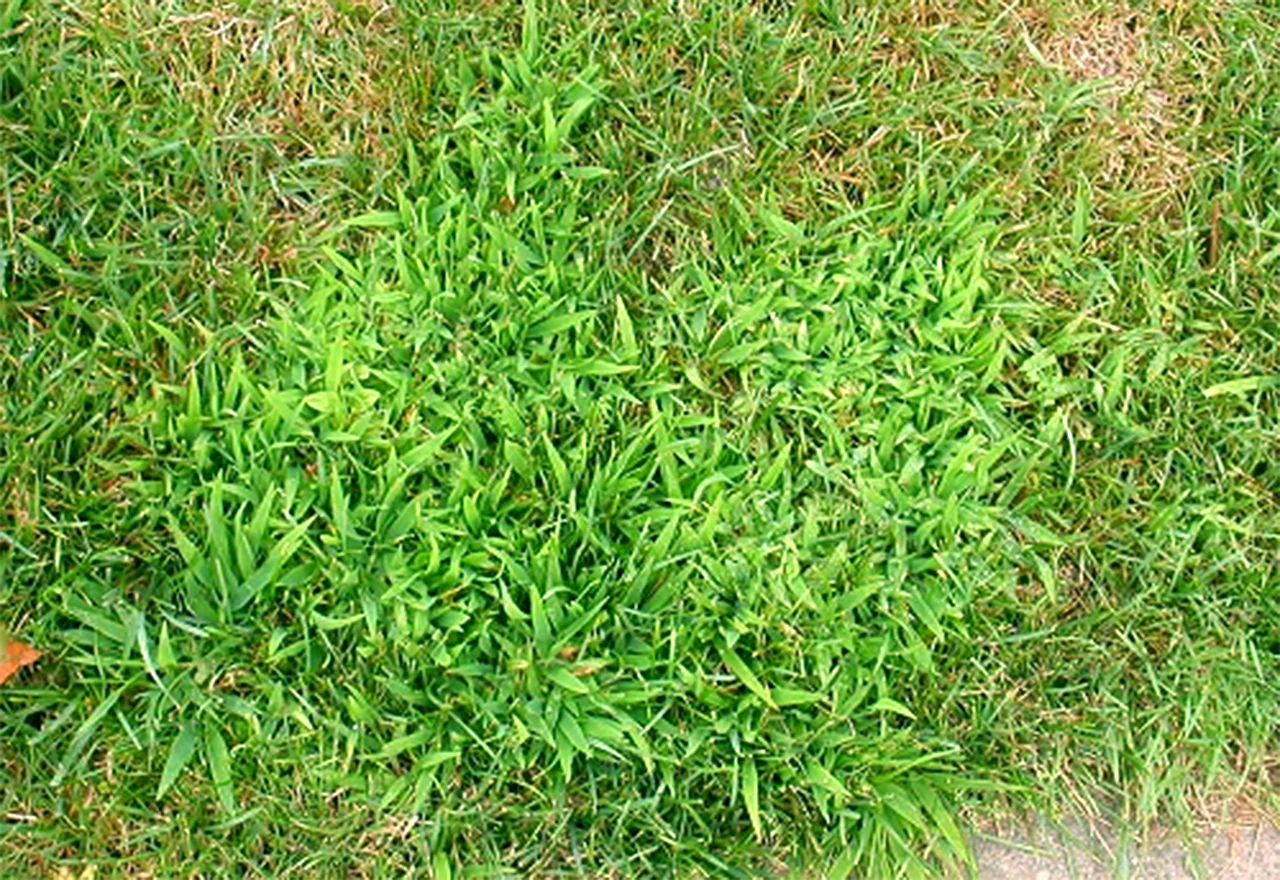
Once it's up, crabgrass gives itself away by color and shape. The blades carry a distinct yellowish-green cast that stands out against healthy turf. Unlike quackgrass and coarse fescue, it grows flat — spreading outward in a low star pattern rather than upward, which conveniently keeps it under the mower blade. A single plant can produce enormous quantities of seed on purplish seed heads. Pull one up and you'll find shallow roots packed in a tight clump, very different from the next two grasses.
How to spot crabgrass: Flat, sprawling growth that hugs the ground; yellow-green blades that contrast with surrounding turf; emerges late in the heat of summer, not early spring; shallow, clumped roots that die off completely every winter.
Quackgrass
Quackgrass is a fast-growing cool-season perennial and a constant stand-in for its annual lookalike. The critical difference: quackgrass doesn't just spread by seed — it pushes out an aggressive underground network of rhizomes, which is why it's so hard to dig out and why it keeps coming back.
The fastest way to tell quackgrass from crabgrass is to look at the leaf where it meets the stem. Both have wide, coarse blades, but quackgrass has a clasping auricle — small claw-like projections where the leaf wraps around the stem. Crabgrass has nothing like it. Add to that growth habit: crabgrass flattens to the ground, quackgrass stands upright and tall.
As a cool-season grass, quackgrass shows up early in spring and grows fast enough to stand out almost immediately — left alone it can reach several feet. Its rhizomes have sharp, pointed tips that drive through even compacted Connecticut clay soils, sending up fresh shoots every few inches. Growth slows in summer heat, but the underground system keeps expanding the whole time, then pushes new shoots again once fall cools down — often while everything else is going dormant.
How to spot quackgrass: Tall, upright growth, not flat like crabgrass; clasping auricles where the leaf wraps the stem; appears early in spring and grows aggressively; spreads by deep underground rhizomes, not just seed.
Coarse, Clumping Fescue
First, an important distinction. When most people say "tall fescue," they mean turf-type tall fescue — a fine-bladed, dense, drought- and heat-tolerant grass that's one of the best lawn grasses for Connecticut, and exactly the type we seed. That desirable grass is not the problem here. The weed is the older, coarse, clumping forage- or pasture-type fescue (the Kentucky 31–style grass), which shows up as wide-bladed, dark clumps that refuse to blend into a fine lawn. Throughout this section, "coarse fescue" refers to that pasture-type contaminant — not the turf-type tall fescue we plant.
This coarse type is a cool-season perennial, and it announces itself in early spring as dark-green patches that green up well before the rest of the lawn does. Growth is strongest in spring and fall, but its deep root system keeps it green through the kind of summer drought and heat that browns out everything around it.
The blades are noticeably coarser and wider than both crabgrass and quackgrass — rough to the touch, with deep ribs you can see with the naked eye and a smooth, glossy underside.
It's a bunch-type grass that grows in distinct colonies with sharp, well-defined borders. It doesn't run underground like quackgrass; instead it sends up upright shoots called tillers from the base of each plant, which limits how far a single patch can spread. It mostly moves by seed. That clumping habit is the giveaway — a coarse, dark, clearly-bordered patch sitting inside a finer lawn. The real issue isn't the species so much as the texture mismatch: coarse clumps standing out against fine-bladed turf.
How to spot coarse, clumping fescue: Coarse, wide blades with a rough texture and visible ribs; dark-green clumps with sharp, defined edges; stays green through drought and summer heat; grows in bunches and doesn't spread by rhizomes.
Let Pro Turf Handle It
Identification is only half the battle — each of these grasses responds to a completely different approach, and the wrong treatment at the wrong time of year is wasted money. Pro Turf Lawn Care knows Connecticut turf, Connecticut soil, and the exact timing these weeds follow across Fairfield, Litchfield, and New Haven counties. Not sure what's taking over your lawn? Let our team identify it and build the right plan — no guesswork, no wasted seasons. Request your online quote here.